
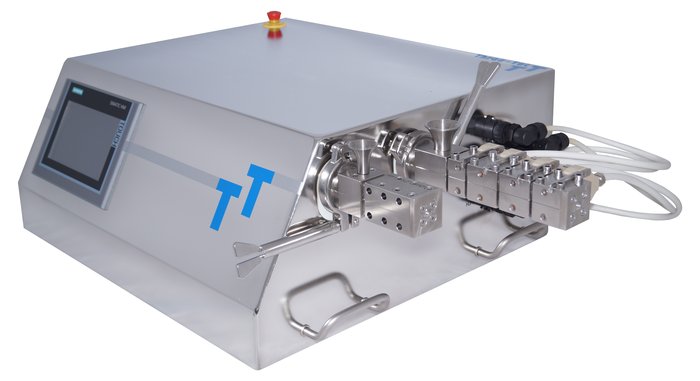
In the early stages of formulation development, only very small quantities of expensive active ingredients are often available, yet finding the optimum formulation requires numerous trials. The ZE Hybrid is a micro-scale twin-screw laboratory extruder developed for exactly this resource-saving need. It is built on the same housing as the standard models and shares the same performance data as the corresponding standard extruders; but as a combination instrument it offers a choice of two different extruder sizes in a single unit — so the scale-up step is already built into the instrument.
Thanks to shared/universal use of heating cartridges, cooling systems, die plates, and pressure and temperature sensors, the instrument can be converted from a 5 mm to a 9 or 12 mm screw diameter within a few minutes. This significantly widens the range of applications compared with conventional extruders and makes it ideal for repeatable scale-up. Both shafts are operated from a single, central control panel.
- Just 1.2 cm³ empty volume (L/D 15:1) at 5 mm screw diameter — the smallest of its kind in the world
- Enables preparations as small as 0.5 grams; very little residue remains in the extruder, giving high yield
- Screw diameter conversion from 5 → 9 or 5 → 12 mm within a few minutes
- Both shafts are operated from a single central control panel
- Results scale directly up to the larger ZE series extruders
Combination Options
Three versions are available; each switches between the two screw diameters below. Each diameter has performance data identical to its own standard ZE HMI model — the hybrid instrument simply combines two housings on a single control panel.
| Combination | Screw Diameters | Pressure Range | Torque Range | Typical Use |
|---|---|---|---|---|
| ZE 5/9 | 5 mm ↔ 9 mm | 200–200 bar | 2.5–14.5 Nm | Transition from micro scale to small laboratory scale |
| ZE 5/12 | 5 mm ↔ 12 mm | 200–250 bar | 2.5–20 Nm | The widest scale range — from micro to medium laboratory scale |
| ZE 9/12 | 9 mm ↔ 12 mm | 200–250 bar | 14.5–20 Nm | Two-stage scale-up within laboratory scale |
Technical Data by Screw Diameter
Each screw diameter on the hybrid instrument retains exactly the same performance data as the corresponding standard ZE HMI model below.
| Parameter | 5 mm | 9 mm | 12 mm |
|---|---|---|---|
| Max. pressure (die) | 200 bar | 200 bar | 250 bar |
| Max. torque (per screw) | 2.5 Nm | 14.5 Nm | 20 Nm |
| Die diameter range | 0.2–3 mm | 0.2–5 mm | 0.2–8 mm |
| Empty volume (L/D 15:1) | 1.2 cm³ | 6 cm³ | 14 cm³ |
| Barrel length (L/D 15:1) | 75 mm | 135 mm | 180 mm |
| Barrel length (L/D 20:1) | 100 mm | 180 mm | 240 mm |
| Barrel length (L/D 25:1) | 125 mm | 225 mm | 300 mm |
| Barrel length (L/D 30:1) | 150 mm | 270 mm | 360 mm |
| Heating zone power | 50 W | 100 W | 100 W |
| Heat-up time to 100 °C | 3 min | 3 min | 4 min |
| Heat-up time to 200 °C | 8 min | 9 min | 11 min |
| Example output (stearyl alcohol, 1 mm die) | 0–0.45 kg/h | 0–1.7 kg/h | 0–2.7 kg/h |
Output values are theoretical figures measured using stearyl alcohol (97%) with a 1 mm round die and standard screw; actual values vary with the material and screw configuration.
Common Technical Data (All Combinations)
| Cooling | Water / Air |
|---|---|
| Number of heating zones | 1–8 |
| L/D ratio options | 15 · 20 · 25 · 30 · 40 |
| Screw speed | 1–300 rpm (higher on request) |
| Control | Single central Siemens HMI panel, shared by both screw diameters |
| Max. temperature | 230 °C (optional 400 °C) |
| Data logging | Per-zone heating temperature, torque, torque trend, speed — USB/Ethernet output |
Materials
| Product-contact parts | Stainless steel, various hardened grades, adapted to the customer's application |
|---|---|
| Seals | PTFE, silicone (up to 230 °C), optional metallic seal up to 400 °C |
Why Hybrid?
By housing two different scales in a single instrument instead of a standard extruder, it saves both laboratory space and investment cost; at the same time, it makes it possible to carry out the scale-up step during development on a single instrument, with consistent hardware and control logic.
Application Areas
The micro-scale hybrid extruder is used for early-stage R&D and pre-scale-up trials in every industry that works with small quantities of expensive raw materials:
| Industry | Applications |
|---|---|
| Plastics | Compounding · Biomaterials · Recycling · Fiber-reinforced plastics · Film extrusion · Filament for 3D printing |
| Food & Feed | Plant proteins · Milk powder · Flour and starch · Chocolate and confectionery · Cultured meat · Pet/fish feed · Extrudates · Enzymes |
| Pharmaceutical | Amorphous solid dispersion (ASD) · Formulation development · Precise feeding of active ingredients · Film extrusion (oral/dermal) · Implant manufacturing · Cleanroom applications |
| Chemical | Polymer production · Mechanochemistry · Pigments and inks · Reactive extrusion · Battery production · Adhesives · Active Pharmaceutical Ingredient (API) synthesis |