
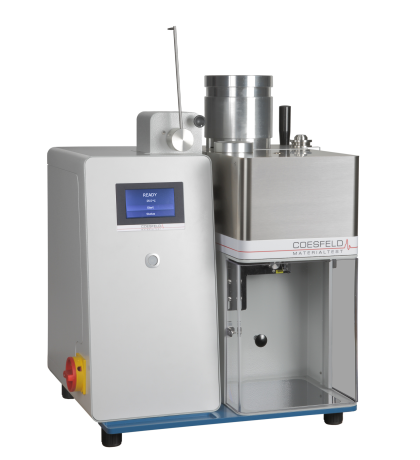
Melt Flow Index (MFI), or melt mass-flow rate (MFR), is the measurement of the flow rate of molten plastic material. This property is used in the plastics industry, particularly for incoming quality control. The test method is described in detail in the ASTM D1238 and ISO 1133 standards.
A small sample of approximately 5 grams is heated to a temperature above its melting or softening point and forced to flow through a barrel using a piston and weight (typically 2.16 kg or 5 kg). The weight of melt extruded in 10 minutes is the melt flow index value. A high MFI value corresponds to low viscosity, while a low MFI value indicates high molecular weight. Melt Flow Index testers are the most widely used instruments in the plastics industry for determining a material's flow properties and comparing values between separate batches of the same material.
Application
The instrument enables fast, precise measurement of melt flow rate at a defined temperature and pressure. The extrusion plastometer can be used for a variety of applications, such as production quality assurance or the development of new materials.
By accurately measuring the flow properties of melts, companies can ensure their products maintain consistently high quality and meet customer requirements. The extrusion plastometer is a reliable, easy-to-use instrument that makes a significant contribution to optimizing processes and increasing efficiency in the plastics and polymer industry.
Features
The Extrusion Plastometer is designed to be flexible and user-friendly. It can be operated with or without Coesfeld WIN-MFR/MVR software, with the active device status shown intuitively via the touch panel. An optional PC connection is available for extended device configuration and measurement data management.
The instrument also has an operating button that allows glove-friendly command entry during the relevant operating step. It can be expanded with various modules — such as a scale, displacement sensors and a lifting platform for automatic MFR/MVR testing — to meet different test requirements and increase the instrument's versatility.
Model Configuration
| Parameter | Basic | Standard | Comfort | Comfort+ |
|---|---|---|---|---|
| Test method | A | A, B, C | A, B, C | A, B, C |
| MFR | ✓ | ✓ | ✓ | ✓ |
| MVR | ✗ | ✓ | ✓ | ✓ |
| Touch Display / Stand alone | ✓ | ✓ | ✓ | ✓ |
| Automatic Cutting Blade | optional | optional | ✓ | ✓ |
| Automatic Die Plug | optional | optional | optional | optional |
| Motorized Weight Loading | ✗ | ✗ | ✓ | ✓ |
| Automatic Compaction Function | ✗ | ✗ | ✗ | ✓ |
| Material Discharge | ✗ | ✗ | ✗ | ✓ |
| Motorized Cleaning | ✗ | ✗ | ✗ | ✓ |
| Automatic Weight Selection and Application | ✗ | ✗ | ✗ | ✗ |
Technical Specifications
| Parameter | Value |
|---|---|
| Test Method | MFR & MVR |
| Display | Touch Display |
| Temperature Range | 50 – 450 °C |
| Temperature Resolution | 0.1 °C |
| Encoder Resolution | 1 µm |
| Time Resolution | 0.01 s |
| Dimensions | 500 × 480 × 620 mm |
| Air Cooling | Optional |
Automatic Die-Plug Option
- Prevents drooling and premature flow from the extrudate
- Provides higher repeatability at high melt rates
- Quick-release design
- The die plug is released automatically when the automatic cutting device is activated