
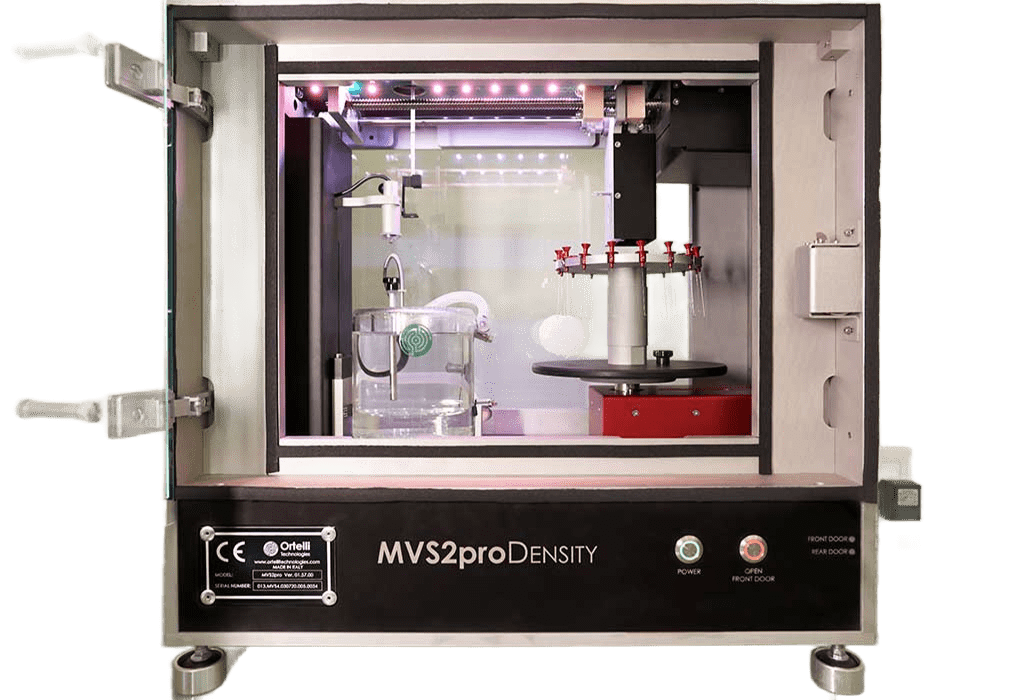
The MVS2pro is a robotic system that measures the absolute density of polymers (MVS) fully automatically using the hydrostatic pressure principle, eliminating the traditional density gradient column method and removing operator-dependent errors and long wait times. While the system was primarily developed for HDPE, it can also be used for other thermoplastic types that can be analyzed with the hydrostatic pressure method. With a 16 sample/standard capacity auto-sampler, an integrated and calibratable Pt100 temperature probe, and five separately certified standards compliant with the ISO 9001 quality process (density, mass, volume, polymer and temperature), every measurement is included in a statistical control plan. The software provides an FDA 21 CFR Part 11–compliant electronic record/signature infrastructure, and allows remote access over the corporate network and data export to LIMS, Excel or Access.
- Method: Hydrostatic (Archimedes) pressure — compliant with ISO 1183-1, ISO 2781, ASTM D792, ISO 4591, and ISO 293 for sample preparation
- Measurement time ~120 sec/sample; auto-sampler capacity 16 samples/standards
- Repeatability <0.01%; operating temperature range 10–50°C (typically 23°C)
- Sample size approximately 4 cm diameter; basket, helix, hook and sink/float-type holder accessories accommodate different sample geometries
- Accuracy/speed balance customizable to need — from recycling and rubber applications to certification-laboratory precision
- Control is provided via a software console over LAN (included in the price); Windows 10 PC, historical data archive and LIMS/Excel/Access export
Why Density Cube Instead of a Gradient Column?
The traditional density gradient column method requires at least 8 hours to prepare the liquid mixture, and the measurement result depends on the polymer's position within the column — a technique open to operator interpretation. The Ortelli Density Cube, by contrast, immerses the sample in a liquid of known, certified density and measures at a constant temperature, fully automatically, producing repeatable results independent of ambient conditions and operator skill.
| Criterion | Density Cube (Hydrostatic) | Gradient Column |
|---|---|---|
| Preparation Time | ~30 minutes | Min. 8 hours (liquid preparation) |
| Measurement Time | ~120 seconds / sample | Depends on sample flow, slow |
| Operator Influence | None (fully automatic) | High (visual reading) |
| Certification | Each component individually certified | Difficult due to gradient stability |
| Data/Network Access | Remote diagnostics, network integration | None |
Measurement Cycle (6 Steps)
- The robotic probe picks up samples and brings them to the measuring system
- The sample is weighed in air on the precision scale
- The sample is immersed in the certified liquid
- The scale takes the measurement while immersed
- The software processes the data
- Results are displayed on screen within seconds
Application Area
Determination of absolute (standard) density for thermoplastic polymers — primarily HDPE, but also LDPE, LLDPE, general PE, PP, PS and PET. Used to verify resin batch consistency and as a fast, low-error alternative to the gradient column for incoming quality control.
Related Products
- Bulk Density & Pourability Testers — bulk density measurement for raw material powder/granules (Coesfeld)