
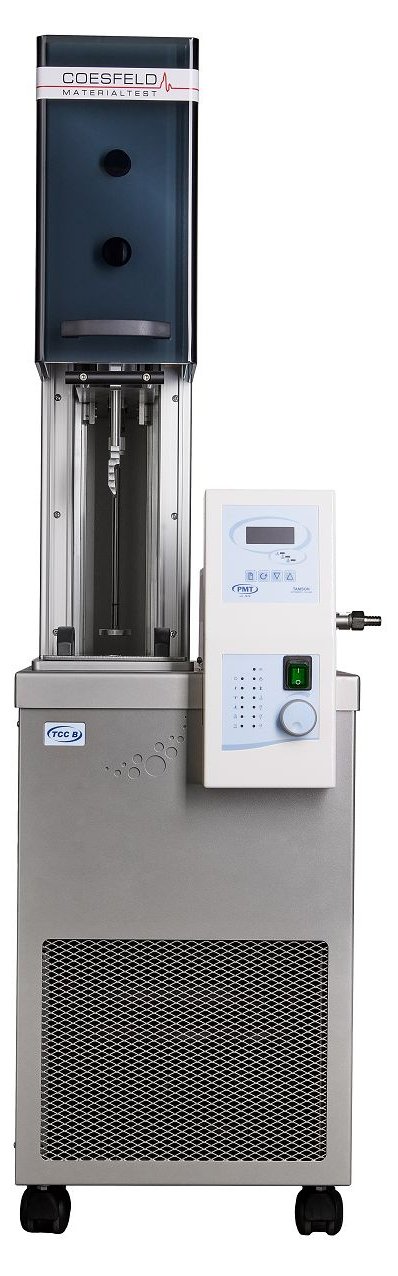
The BTT determines the temperature at which plastics that are not rigid at normal ambient temperature exhibit brittleness (brittle failure) under defined impact conditions. The device has two main components: a drop tower and a cooling unit. Temperature is set directly from the cooling unit's front panel; the unit runs on a continuously operating, ozone-friendly compressor and an electronic heater that precisely controls temperature.
The specimen holder module, fitted with a floating guard, is placed in the cooling bath. A mechanical trigger releases the impact hammer into free fall, accelerating it to 2 m/s as it strikes the specimens. The 15 kg drop mass and approximately 30 J of energy keep the impact speed constant throughout the test, allowing up to 10 specimens to be tested at once — eliminating the need for two groups of five.
- Ozone-friendly, continuously running compressor and precise temperature control (±0.05 K)
- Floating-guard specimen holder — prevents broken specimen fragments from floating in the bath
- Constant impact speed — stays at 2 m/s throughout the test
- 15 kg drop mass, ~30 J energy — higher specimen throughput
- Interchangeable specimen holder; separate clamp options for Method A and Method B
- CFC/HCFC-free cooling fluid (e.g. methanol)
Application
Determining the temperature at which flexible/non-rigid plastics at normal ambient temperature become brittle under defined impact conditions at low temperature. Used in automotive, cable/insulation, packaging and general plastics/elastomer quality control.
Technical Specifications
| Parameter | Value |
|---|---|
| Drop height | Up to 240 mm |
| Drop speed | 2 m/s |
| Drop mass | 15 kg (~30 J) |
| Specimen holder | Interchangeable — Method A and Method B |
| Temperature range | -85 °C to +20 °C (up to room temperature) |
| Cooling time | ~120 min (from +20 °C to -80 °C) |
| Temperature setting accuracy | 0,1 K |
| Temperature control accuracy | ± 0,05 K |
| Cooling medium | E.g. methanol |
| Refrigerant | CFC / HCFC free |
| Bath capacity | 11 l |
| Dimensions (HxWxD) | ~1470 x 380 x 780 mm |
| Weight | ~120 kg |
| Electrical connection | 230 V / 50 Hz (optional 230 V / 60 Hz or 115 V / 60 Hz) |
| Power | 2600 – 2800 W |
| Compressed air | 6 – 8 bar |
Specimen Clamping Fixture Options
| Description | Standard |
|---|---|
| Clamp Type A, without stop mechanism | ASTM D746 |
| Clamp Type A, with stop mechanism | ASTM D2137 & ISO 812 |
| Clamp Type A, 5.7 mm — specimen thickness 1.05–1.64 mm | ASTM D2137 |
| Clamp Type A, 5.2 mm — specimen thickness 0.55–1.04 mm | ASTM D2137 |
| Clamp Type A, 4.8 mm — specimen thickness 0.10–0.54 mm | ASTM D2137 |
| Clamp Type A, for 10 specimens | ASTM D746 |
| Clamp Type B, for 15 specimens | ASTM D746 & ISO 974 |
Standard – Specimen – Clamp Configuration
Each standard requires a different clamp selection based on its own specimen type and size:
| Standard | Specimen Type | Recommended Clamp |
|---|---|---|
| ISO 812 | Type A | Type A, 5 specimens |
| Type B | Type A, 5 specimens | |
| ISO 974 | — | Type B, 15 specimens |
| ASTM D746 | Type I | Type A, 5/10 specimens |
| Type II | Type A, 5/10 specimens | |
| Type III | Type B, 15 specimens | |
| ASTM D2137 | Type A | Type A, 5/10 specimens |
| Type B, 1.65–2.20 mm (standard) | Type A, 5 specimens | |
| Type B, 1.05–1.64 / 0.55–1.04 / 0.10–0.54 mm | Type A, 5 specimens |
Note: the old 'Type A/B' naming in ASTM D2137 has been updated — in the current standard, the old Type B is now Type A, and the old Type A is now Type B.