
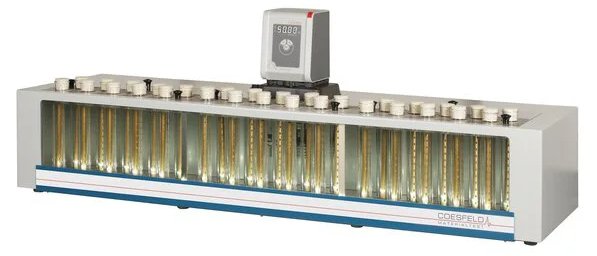
The ESCR tester comprises a temperature-controlled bath with a rack holding 10 or 50 test tubes. Each test tube holds 10 specimens. A notching unit with a notching blade is supplied with the device for specimen preparation. Notched specimens are pre-stressed with a bending clamp and placed in the brass specimen holder using the transfer tool.
10 test tubes are placed in a rack; this rack can be removed from the bath for specimen preparation and returned to the bath for testing. The 50-station model can hold up to 5 specimen racks, so it can be configured as a 10/20/30/40/50-station unit. Up to 300 specimens can be viewed through the front window, and up to 500 can be tested at the same time.
The distinguishing feature of the Coesfeld ESCR unit is its wide glass front with integrated LED lighting, which allows specimens to be examined while remaining in the bath — making measurement quick and clean.
- Two models with 10 or 50 stations — capacity up to 100 and 500 specimens respectively
- Removable glass specimen rack — prepare a full test series at the bench and load it into the bath in one go
- Wide glass front with integrated LED lighting — inspect specimens without removing them from the bath
- Includes a 10-specimen brass specimen holder, bending clamp and transfer tool
- ±0.1 °C temperature stability, operating range from room temperature+10 °C to 150 °C
Application
The ESCR test measures the susceptibility of ethylene-based plastics (especially PE) to environmental stress cracking. Under defined strain conditions and in the presence of media such as soap, wetting agent, oil or detergent, ethylene plastics can show mechanical damage through cracking. Bent specimens cut from the plastic, each with a controlled defect (notch) on one surface, are exposed to a surfactant. The proportion of specimens that crack within a given time is observed.
Model Comparison
| Parameter | 10-Station Unit | 50-Station Unit |
|---|---|---|
| Capacity | Up to 100 specimens | Up to 500 specimens |
| Dimensions (W x D x H) | 526 x 440 x 476 mm | 1331 x 440 x 476 mm |
| Bath volume | ~24 l | ~72 l |
| Weight (empty) | ~35 kg | ~75 kg |
| Temperature range | Room temperature+10 °C – 150 °C | |
| Temperature stability | ± 0,1 °C | |
| Electrical connection | 230 V 50 Hz / 230 V 60 Hz / 115 V 60 Hz — 2000 W | |
Accessories
| Part | Description |
|---|---|
| Cover | Cover that closes the bath opening when no specimen rack is fitted; 1 required per opening. |
| Specimen rack | Rack holding up to 10 test tubes; at least 1 per unit, up to 5 racks for the 50-station unit. |
| Test tube | Outer Ø 36 mm, inner Ø 32 mm, length 225 mm; 1 per specimen holder. |
| Test tube tongs | For holding the test tube; 1 per unit. |
| Cork stopper | 1 per test tube. |
| Brass specimen holder | For 10 specimens; 1 per test tube. |
| Notching fixture (without dial gauge) | For cutting the specimen; 1 per unit. A notch depth gauge must be ordered separately. |
| Notch depth gauge (dial gauge) | For the notching fixture; 1 per fixture. |
| Notching blade | Pack of 5 or 200; one blade can notch approx. 100 specimens. |
| Bending clamp | For bending 10 specimens at once; 1 per unit. |
| Transfer tool | For transferring the specimen from the bending clamp to the brass holder; 1 per unit. |