
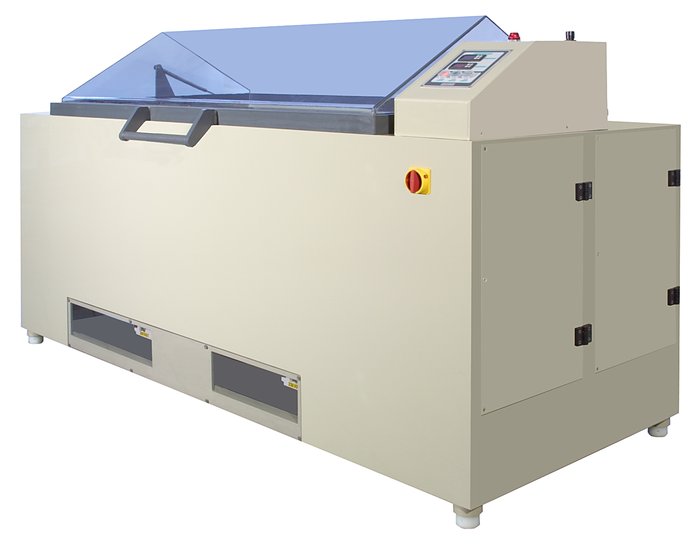
Materials used in manufacturing industries worldwide are exposed to natural or industrial corrosion in the form of salt spray, humidity, soot and exhaust gas. Corrosionbox chambers produce reliable, comparable laboratory results for predicting the corrosion resistance of materials such as paints and coatings.
The housing is made entirely of 10 mm thick corrosion-resistant PP plastic material (optional PPS housing for CSA fire-resistance testing), double-wall insulated. The salt solution tank is integrated into the housing; the control panel and all maintenance points (electrical panel, solenoid valves, humidifier, dosing pump) are grouped in a single zone for easy access. The Vertical series, with its compact glass-door design, suits narrow laboratory spaces; the Horizontal series, with a drip-preventing angled-profile transparent pivot cover, allows for larger sample loading.
- Vertical: 400 L and 1000 L; Horizontal: 600 L and 1000 L volume options
- Basic model — timer up to 9999 hours, digital temperature control, salt-shortage warning light
- Enhanced model — microprocessor control, 4x20 character LCD, 15 test programs, RS232-C report output
- ISO 9227 AASS/CASS–compliant plastic spray nozzle and central fog diffuser
- Cyclic test option (salt spray + condensation + dry air) on enhanced models
- Optional Dry Corrosion / Prohesion (ASTM G85 Annex 5) / salt-SO₂ (ASTM G85 Annex 4) equipment
Introduction Video
Choosing a Housing Type — Vertical or Horizontal?
| Feature | Vertical (Dikey) | Horizontal (Yatay) |
|---|---|---|
| Access | Hinged glass front door | Pivoting transparent top cover, watertight |
| Volume options | 400 L / 1000 L | 600 L / 1000 L |
| Layout advantage | Narrow space, vertical footprint | Large sample tray, easy top loading |
| Typical use | Small-to-medium sample volume, frequent checks | Large parts / many samples, low drip risk |
Corrosionbox Vertical — Technical Data
| Parameter | 400 L Basic / Enhanced | 1000 L Basic / Enhanced |
|---|---|---|
| External dimensions (WxDxH) | 1320 × 780 × 1450 mm | 1640 × 880 × 1800 mm |
| Interior volume (excluding dome) | 800 × 700 × 800 mm · 448 L | 1100 × 800 × 1140 mm · 1000 L |
| Weight | 168 kg | 300 kg |
| Salt solution tank | 110 L | 260 L |
| Electrical connection | 230 V ±10% · 50 Hz · 1/N/PE | |
| Current draw | 9 A | 14 A |
| Water supply | Demineralized, 2–4 bar, ~3 L/day | |
| Air supply | Filtered, oil-free, 4–6 bar, 5–8 Nm³/h | |
| Chamber / humidifier temperature range | Ambient–50 °C / Ambient–70 °C | |
| Standard accessories (rods / sample rack) | 4 / 3 | 6 / 4 |
Corrosionbox Horizontal — Technical Data
| Parameter | 600 L Basic / Enhanced | 1000 L Basic / Enhanced |
|---|---|---|
| External dimensions (WxDxH) | 2010 × 760 × 1400 mm | 2400 × 1000 × 1365 mm |
| Interior volume (excluding dome) | 1300 × 650 × 700 mm · 600 L | 1690 × 890 × 700 mm · 1050 L |
| Weight | 300 kg | 400 kg |
| Salt solution tank | 130 L | 160 L |
| Electrical connection | 230 V ±10% · 50 Hz · 1/N/PE | |
| Current draw | 9 A | 12 A |
| Water supply | Demineralized, 2–4 bar, ~3 L/day | |
| Air supply | Filtered, oil-free, 4–6 bar, 5–8 Nm³/h | |
| Chamber / humidifier temperature range | Ambient–50 °C / Ambient–70 °C | |
| Standard accessories (rods / sample rack) | 4 / 3 | 6 / 4 |
Differences Between Basic and Enhanced Models
| Feature | Basic | Enhanced |
|---|---|---|
| 10 mm polypropylene housing, integrated salt tank | ✔ | ✔ |
| Transparent, drip-preventing cover | ✔ | ✔ |
| ISO 9227 AASS/CASS–compliant spray nozzle | ✔ | ✔ |
| Pressure gauge / regulator | ✔ | Regulator present, no gauge |
| Digital temperature control | ✔ | – (via microprocessor) |
| Timer (up to 9999 hours) | ✔ | – |
| Salt-shortage warning light | ✔ | – |
| Microprocessor control / 4×20 LCD | – | ✔ |
| 15 different test programs | – | ✔ |
| Self-diagnostics / alarm / safe shutdown | – | ✔ |
| Full test report (RS232-C output) | – | ✔ |
| Cyclic test programming (salt/condensation/dry/ambient) | – | ✔ |
Test Methods
| Test | Description |
|---|---|
| Salt Spray | The corrosive solution is atomized by a nozzle at the center of the chamber; a fog diffuser tower distributes it evenly across the test zone. The compressed air needed to generate the fog is heated and saturated with moisture in a pressurized humidifier before reaching the nozzle. Applicable to all models. |
| Condensation | The chamber floor is filled with demineralized water; the water is heated to evaporate and condenses on the sample surface. Chamber temperature is 40 °C. Applicable to all models. |
| Cyclic Corrosion | A combination of salt spray, humidity condensation and dry air steps; possible only on enhanced models, with optional equipment depending on cycle type. |
Cyclic Test Options (Enhanced Models)
| Option | Description |
|---|---|
| Dry Corrosion / Scab Corrosion | An air heater warming the drying air entering the chamber and a titanium panel converting the chamber floor into a dry floor are added; the dry floor alone allows samples to dry quickly. |
| Prohesion (ASTM G85-98 Annex 5) | In addition to the dry corrosion equipment, a bypass line is added to the humidifier to meet the fog generation standard. |
| Salt/SO₂ Spray (ASTM G85-98 Annex 4) | An external SO₂ dosing system and a gas diffuser device inside the chamber are added. |
Supported Standards
Basic Models:
Additionally on Enhanced Models — Dry / Prohesion:
Application Areas
Automotive (OEM corrosion specifications), metal plating and galvanizing, paint and powder coating systems, electronics/connector corrosion testing, aerospace and defense industry (MIL-STD-810), general quality control and R&D.