
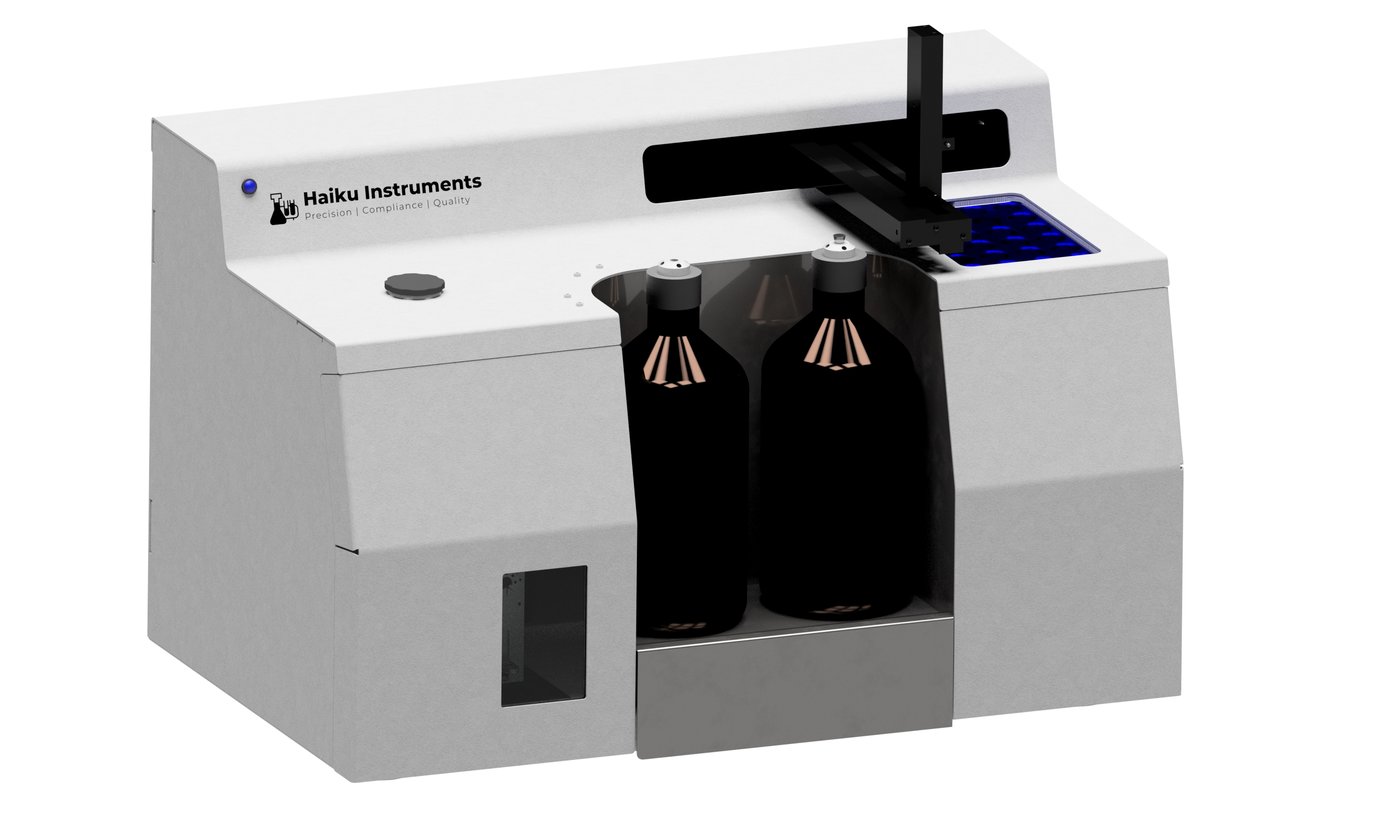
The Model 575 Intrinsic Viscometer Generation 2 measures intrinsic viscosity ([η]) — a value directly related to a polymer's molecular weight — using a fully automated dual-differential capillary viscometer. The system autonomously runs the entire process, from sample weighing through dissolution, injection and result calculation, requiring only about 1 minute of operator attention per sample. Designed and manufactured by Houston, Texas–based Haiku Instruments, the instrument is based on the ASTM D5225 standard, and thanks to improvements patented in 2023, it can handle at least 3 times the sample workload of comparable viscometers.
- Dual differential pressure measurement: fluctuations in solvent flow rate cancel out, unlike single-capillary systems whose results depend on flow stability
- 24 individually stirred autosampler positions; the dissolution program is set automatically based on solvent viscosity and expected sample IV
- Inline filtration and automatic backflush for filled or reinforced samples (glass fiber, carbon black, inorganic fillers); insoluble particles do not clog the capillaries
- k-value, widely used in PVC markets outside North America, is calculated automatically alongside intrinsic viscosity from the same measurement
- LIMS/ERP integration, CSV/Excel export and 21 CFR Part 11–compliant electronic records; connects to a Windows PC over USB
What is Intrinsic Viscosity?
Intrinsic viscosity [η] is a measure of a polymer's contribution to a solution's viscosity, independent of concentration and intermolecular interactions. It is derived step by step from relative viscosity (sample vs. solvent) and specific viscosity, then extrapolated to the limit as concentration approaches zero. Its practical value lies in the relationship between intrinsic viscosity and molecular weight (Mark–Houwink equation): [η] = K · Mα, where K and α are constants specific to the polymer–solvent system and M is the viscosity-average molecular weight. In other words, once intrinsic viscosity is known, a polymer's average molecular weight can be calculated directly — without a separate molecular weight measurement.
Measurement Principle — Dual Differential Viscometry
Classical intrinsic viscosity measurement relies on time-based, gravity-flow glass tube viscometers (Ubbelohde, Ostwald type). While these devices can be automated with electric-eye sensors and vacuum-based sample loading, they remain limited in principle compared to a pressure-based, forced-flow system. The Model 575 measures two differential pressures (ΔP) simultaneously at all times: ΔP1 always reads the solvent, while ΔP2 reads the solvent at baseline and the sample at plateau. Any fluctuation in flow rate and the resulting pressure changes cancel out between the two channels, so the resulting relative viscosity depends only on the viscosity of the solutions — not on pump stability, tubing length or diameter.
| Criterion | Model 575 (Automated, Forced Flow) | Traditional Glass Tube (Manual) |
|---|---|---|
| Operator time per sample | ~1 minute | 60+ minutes |
| Sample throughput | Up to 3x higher | Reference |
| Solvent consumption & disposal | 3–5x lower | Reference |
| Operator exposure to solvent vapor | Minimal — no manual handling steps | At every preparation and measurement step |
| Sensitivity to flow-rate fluctuation | None (dual-channel cancellation) | High (single flow path) |
Automated Workflow: Preparation — Dissolution — Analysis
The fully integrated system requires only about one minute of user time per sample; every other step runs automatically.
| Workflow Step | Critical Advantage |
|---|---|
| Sample Mass Determination | Guided weighing workflow with a connected analytical balance |
| Solvent Dispensing | Fully automated; zero user interaction with solvents |
| Dissolution | 24 individually stirred autosampler positions |
| Sample Analysis | Begins automatically after dissolution; each sample is injected and analyzed twice |
Application Area
Used for molecular weight monitoring and quality control across a wide range of polymers — primarily polyesters and PET (including bottle- and fiber-grade resins and recycled rPET), and also polycarbonate, PVC, polystyrene, biopolymers and polyolefins.
Technical Specifications
| Criterion | Specification |
|---|---|
| Viscosity Measurement Type | Dual Differential, Relative Viscosity, Forced Flow |
| IV Measurement Resolution | 0.005 dL/g |
| Measurement Precision | Better than 0.2% RSD RV @ 0.800 dL/g |
| Shear Rate | 200–500 s⁻¹ (typical, application-dependent) |
| Sample Analysis Time | 4–6 minutes per sample, including duplicate injection |
| Solvent Compatibility | Organic, aqueous, acids, halogenated |
| Temperature Range (Dissolution) | 30°C – 160°C |
| Temperature Range (Analysis) | 10°C – 160°C |
| Autosampler Capacity | 24 individually stirred positions |
| Solvent per Sample | 25 mL (preparation + analysis + wash) |
| Data & Integration Options | LIMS/ERP, data parsing, Excel/CSV export |
| Compliance Support | 21 CFR Part 11 |
| Connection & Operating System | USB / Windows 10 or 11 |
Sample Considerations
- Filled/finished samples: for samples containing glass fiber, carbon black or inorganic fillers, the % polymer fraction of the sample mass can be calculated before or after analysis, matching your lab's workflow
- k-value for PVC: a direct side-by-side calculation of both k-value and intrinsic viscosity is available for PVC users, per market convention outside North America
- System suitability: linearity is checked at increasing flow rates through both capillaries before each run, confirming that results depend only on solution viscosity